
How Do I Plant a Staggered Double-Row Hedge?
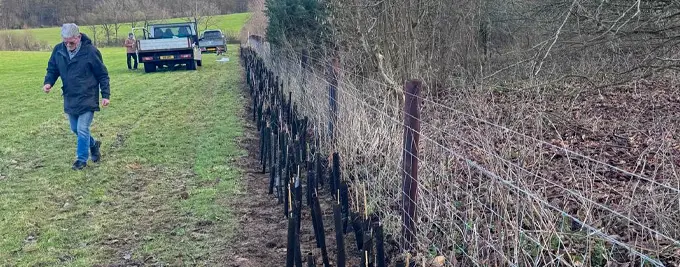
A staggered double row creates a broader hedge by arranging plants in a zigzag rather than directly opposite one another. Correct spacing depends on the species, plant size, root type and the total number of plants recommended per metre.
Quick Answer
Mark two parallel planting lines and position each plant in the second row opposite a gap in the first, creating a zigzag pattern. Use the product’s plants-per-metre recommendation across both rows, not in each row. At five plants per metre, a common layout is two rows approximately 30cm apart, with plants about 40cm apart along each row and the second row offset by 20cm. Plant at the original soil level, firm carefully, water thoroughly and mulch.
Quick Facts
| Layout | Two parallel rows with plants arranged in a zigzag |
|---|---|
| Common density | Five plants per metre in total across both rows |
| Typical row spacing | Approximately 30cm for many small mixed native hedge packs |
| Spacing at five plants per metre | Approximately 40cm between plants along each row |
| Second-row offset | Approximately 20cm at five plants per metre |
| Best suited to | Smaller bare-root plants, whips and mixed native hedging |
| Space required | More planting and maintenance width than a single-row hedge |
| Planting depth | Original nursery soil mark or top of root ball level with the ground |
What is a staggered double-row hedge?
A staggered double-row hedge consists of two parallel rows of plants. The plants in the second row are offset so that each one sits opposite a gap in the first row.
Viewed from above, the plants form a zigzag rather than pairs standing directly opposite one another. This spreads the plants across a wider strip and helps their branches grow together from both directions.
A double row is commonly used for smaller bare-root plants, young whips and mixed native hedging. It can also be specified for landscaping, environmental and countryside planting projects.
It is not automatically the best layout for every hedge. Larger pot-grown plants, substantial root balls and naturally bushy evergreen hedging may only require a single row. Always use the density shown for the exact plant size and root type being ordered.
How far apart should the two hedge rows be?
For many small bare-root and mixed native hedges, the two rows are positioned approximately 30cm apart, measured from the centre of one row to the centre of the other.
Some specifications use a different measurement. For example, standard Hedging Plants Direct mixed native metre packs use rows approximately 30cm apart, while the Countryside Stewardship BN11 layout uses rows 40cm apart. A grant-funded or professionally specified hedge should always follow the approved plan rather than a general domestic recommendation.
Leave enough overall width for:
- The roots to be spread naturally.
- Branches to develop from both rows.
- Future clipping and maintenance.
- Access without plants obstructing a path, gate or neighbouring boundary.
A double row should not be squeezed into a narrow space simply to fit more plants into the hedge.
How do I calculate the spacing between plants?
The plants-per-metre figure normally refers to the total number of plants across both rows.
It does not mean that the stated number should be planted in each row. Planting five plants per metre in both rows would use ten plants per metre and could create unnecessary competition and overcrowding.
For an evenly spaced two-row hedge, use this calculation:
Spacing along each row in metres = 2 ÷ total plants per metre
| Total plants per metre | Approximate spacing along each row | Offset for second row |
| 5 plants | 40cm | 20cm |
| 6 plants | 33cm | 16–17cm |
| 7 plants | 29cm | 14–15cm |
The offset is half the distance between plants along the row. This places each plant in the second row centrally between two plants in the first.
These calculations are a setting-out guide. Product-specific instructions take priority because plant size, growth habit and the requirements of the project can change the recommended density.
Example calculation for a 10-metre hedge
A 10-metre hedge planted at five plants per metre needs:
10 metres × 5 plants = 50 plants
The plants are divided approximately equally between the two rows, giving around 25 plants in each row.
Space the plants about 40cm apart along each row and start the second row approximately 20cm further along the hedge line. This creates the staggered pattern.
For standard Hedging Plants Direct mixed native packs, one metre pack contains five plants for one metre of finished hedge. A calculator showing one pack per metre does not mean one individual plant per metre.
How do I mark out a staggered double row?
1. Measure the complete hedge line
Measure the intended planting length and subtract any gates, paths, visibility areas or deliberate gaps.
Check for underground cables, pipes and drainage before digging.
2. Mark the first row
Use canes and a tight string line to mark the position of the first row. Make sure the line follows the intended boundary without placing the mature hedge too close to a path, fence or building.
3. Mark the second row
Run a second string line parallel to the first. Use the required row spacing, commonly around 30cm for smaller mixed native planting.
Measure the distance at several points so the rows do not gradually move closer together or further apart.
4. Lay out the plants before planting
Position the plants on the ground beside the string lines while they are still protected in their bags or pots.
Place the first row at the calculated spacing. Start the second row halfway between the first two plants so every plant sits opposite a gap.
Laying out the complete section before digging makes it easier to check the quantity, spacing and distribution of different species.
How should I prepare the planting area?
Clear grass, perennial weeds, brambles and unwanted roots from a strip wide enough to contain both rows.
You can prepare one broad trench for the complete double row or dig individual planting holes where this is more appropriate for larger pot-grown plants. The prepared area must be wide enough for roots to spread without being bent back or forced into a narrow hole.
Loosen compacted soil at the bottom and sides of the planting area. Do not work heavy clay while it is saturated because digging wet clay can smear and compact the soil.
Where soil improvement is needed, mix a moderate amount of peat-free hedge planting compost with the excavated soil. It should improve the existing ground rather than completely replace it.
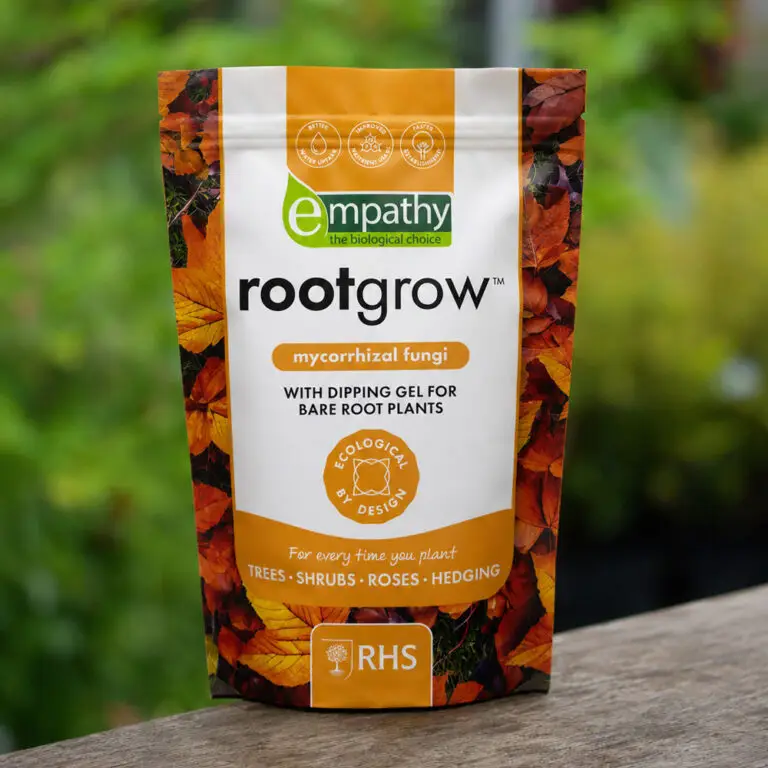
Optional Rootgrow Mycorrhizal Fungi should be applied directly against the roots in accordance with the product label. It does not replace correct planting depth, soil preparation or watering.
How do I plant the two rows?
Plant bare-root hedge plants
Keep bare roots covered until each section is ready to plant. Exposed roots can dry quickly, particularly in bright or windy weather.
Place each plant so the previous nursery soil mark on the stem is level with the finished ground. Spread the roots naturally and avoid folding long roots into a small planting hole.
Plant pot-grown hedge plants
Water dry pots before planting. Remove the container and check the outside of the root ball for tightly circling roots.
Gently loosen the outer roots where necessary and position the top of the root ball level with the surrounding soil.
Backfill and firm the soil
Return the excavated soil around the roots, working it carefully into larger gaps.
Firm the ground gently so the plants remain upright, but do not heavily compact the complete planting strip. Recheck the staggered alignment before moving to the next section.
Do not place concentrated fertiliser directly into the trench or against new roots. Feed cannot compensate for poor drainage, incorrect planting depth or inadequate watering.
How should I water a double-row hedge?
Water both rows thoroughly immediately after planting. The water should reach the original roots and the surrounding prepared soil rather than wetting only the surface.
A double row contains more plants and covers a wider root area than a single row, so check moisture across the complete planting strip. Do not assume that watering down the centre has reached the outside roots of both rows.
During dry weather, inspect the soil below the surface and water deeply when the root zone begins to dry. Long hedge runs may benefit from a properly installed hedge irrigation system positioned to water both rows.
Apply mulch over the planting strip to reduce weed growth and slow moisture loss. Keep mulch clear of the stems rather than piling it against the base of the plants. Hedging Plants Direct recommends condition-led watering through the first two growing seasons, with sandy and exposed sites generally drying more quickly than heavier ground.
When is a double row not suitable?
A single row may be preferable where:
- The available planting strip is narrow.
- The hedge is beside a frequently used path.
- Large pot-grown or root-balled plants are being used.
- The selected species naturally produces broad, dense growth.
- Access for clipping both sides will be difficult.
- The individual product already specifies a single-row density.
- The additional water requirement cannot be managed.
A double row should be selected because it suits the plants, site and intended hedge, not simply because it uses more plants.
For broader planting guidance, including preparation for different root types, read our guide to planting a hedge.
For spacing and aftercare relating specifically to prepared wildlife and countryside mixes, see the Native Mixed Hedging Care Guide.
Common double-row planting mistakes
Counting the density twice
Five plants per metre normally means five plants in total across both rows, not five plants in each row.
Planting the rows directly opposite each other
The plants should alternate. Directly paired plants do not create the intended zigzag layout.
Confusing row spacing with plant spacing
The distance between the two rows is measured separately from the distance between plants along each row.
Ignoring the product specification
A general five-plants-per-metre recommendation should not replace the instructions for a particular variety, size, root type or environmental agreement.
Allowing the roots to dry out
Open one bare-root bundle at a time and keep the remaining roots wrapped and protected.
Watering only one side
Check that water reaches the root area beneath both rows, particularly on long runs, banks and exposed sites.
Failing to allow for the mature width
A double row creates a broader hedge. Leave enough room for future growth, clipping and access before deciding where the first string line should be positioned.
Gwynne's Grower's Tip
On a long hedge, mark every full metre before setting out the individual plants. Measuring each new plant from the previous one can allow small errors to build up, leaving plants crowded at one end and widely spaced at the other. At five plants per metre, one metre will often contain three plants in one row and two in the other, with the pattern naturally reversing in the next metre. Lay the plants out and count the entire section before exposing bare roots, then keep each unopened bundle covered until you are ready to plant it.
Related Products
Products from our nursery that are relevant to this advice.


Useful Planting Essentials
Selected products that may help with planting, establishment and ongoing hedge care.
Rootgrow Mycorrhizal Fungi
Rootgrow can be applied at planting so the product is in direct contact with the roots, where appropriate for the plant and planting method.
View product
Hedge Irrigation
A hedge irrigation system can make it easier to water a new hedge consistently, particularly on longer runs and during dry weather.
View product
Hedge Compost & Mulch
Compost and mulch can support soil preparation, moisture retention and weed suppression when used appropriately around new hedging.
View product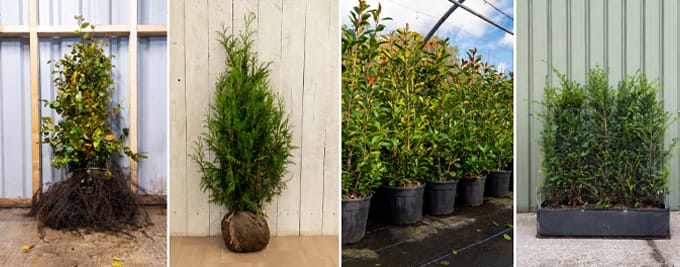
What Are the Different Hedging Root Types?
Bare root, root ball, pot-grown and instant hedging suit different budgets, planting times and levels of initial coverage. Understanding how each is…
Read answer
What Is the Best Soaker Hose for Hedges?
A well-chosen soaker hose makes it easier to water a hedge evenly without wetting the foliage or carrying a watering can along…
Read answer
What Is the Best Watering System for a Hedge?
A good hedge watering system should deliver moisture slowly and evenly along the whole planting line. The most suitable setup depends on…
Read answer
Why Is My Hedge Turning Brown?
A hedge can turn brown for several very different reasons, including dry roots, waterlogged soil, frost, wind, trimming damage or disease. The…
Read answer
Can I Replace a Box Hedge With Green Spire After Box Blight?
Green Spire is one of the closest Euonymus alternatives to a neat low Box hedge. A previous box-blight outbreak does not infect…
Read answer
When Is the Best Time to Plant Hornbeam Hedging?
Hornbeam can be planted in several different forms, and the best planting time depends mainly on whether the plants are supplied bare…
Read answer
How Much Mycorrhizal Fungi Should I Use?
The correct amount of mycorrhizal fungi depends on the size and root type of the plants being treated. Calculating the quantity before…
Read answer
How Long Can Bare-Root Plants Be Stored?
Bare-root plants are vulnerable once they have been lifted because their exposed roots can dry out quickly. Correct temporary storage can protect…
Read answer