
How Can You Tell Male and Female Holly Plants Apart?
Male and female English Holly plants can look almost identical for most of the year. The easiest time to tell them apart is when they flower, because the small white flowers contain different reproductive structures.
Quick Answer
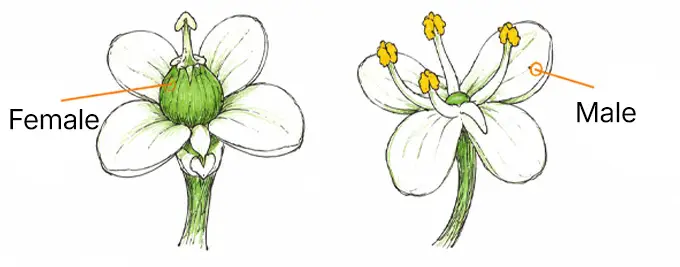
The most reliable way to tell male and female Holly plants apart is to examine their flowers in spring. Male Holly flowers have obvious pollen-bearing stamens, usually with yellowish anthers around the centre. Female flowers have a more noticeable rounded green structure in the middle, formed by the ovary and stigma. Only female plants can produce Holly berries after successful pollination. Leaves, prickliness and overall plant shape are not reliable ways to determine the sex.
Quick Facts
| Botanical name | Ilex aquifolium |
|---|---|
| Reproductive type | Usually dioecious, with male and female flowers on separate plants |
| Best time to identify sex | When the plant is flowering in spring |
| Male flower | Prominent stamens with pollen-bearing anthers |
| Female flower | Rounded green ovary and stigma in the centre |
| Which plants produce berries? | Pollinated female plants |
| Can leaves identify the sex? | No, leaf shape and prickliness are not reliable indicators |
| Can young plants be sexed? | Usually not reliably until they flower, unless their sex is already known from the cultivar or propagation material |
Look at the Holly flowers rather than the leaves
English Holly, Ilex aquifolium, is normally dioecious, which means the male and female flowers are produced on separate plants. A Holly plant is therefore usually either male or female rather than carrying fully functional flowers of both sexes.
For most of the year, telling the two apart by appearance is extremely difficult. Male and female plants can have the same glossy green foliage, prickly leaves and general growth habit.
The most reliable opportunity comes when Holly flowers in spring. Look closely at several freshly opened flowers on the same plant rather than trying to judge the plant from a distance.
What does a male Holly flower look like?
Male Holly flowers contain conspicuous stamens, the structures that produce pollen.
On common Holly these are arranged around the centre of the small white flower. At the end of each stamen is an anther, which may appear yellowish when carrying pollen.
The central female structure of a male flower is reduced and does not develop into a fruit.
If you examine a flowering Holly and repeatedly find flowers with prominent pollen-bearing stamens, you are most likely looking at a male plant.
What does a female Holly flower look like?
Female Holly flowers also have small pale or white petals, but the centre looks different.
Instead of the prominent fertile stamens seen on a male flower, look for a rounded green structure in the centre. This contains the ovary and stigma.
The stamens visible around a female flower are reduced and do not produce functional pollen. If the flower is successfully pollinated, the ovary in its centre develops into the familiar Holly fruit.
It can take a close look to see the difference, particularly on a dense hedge. Examining several flowers with a magnifying glass or the zoom function on a phone camera can make identification much easier.
Can you tell male and female Holly apart by the leaves?
No. Leaf shape is not a dependable way of identifying the sex of English Holly.
Both male and female Ilex aquifolium plants can produce dark green, glossy and strongly spined foliage. The amount of prickliness can also vary according to the age and position of the growth. Older Holly trees commonly develop smoother leaves higher up the plant.
A particularly prickly Holly is therefore not necessarily male or female.
The overall height, growth rate and density of the plant are also unreliable indicators.
Do Holly berries prove that a plant is female?
Yes. If an English Holly plant is carrying berries, you can be confident that it is female.
Only female flowers develop into fruit after successful pollination.
However, the reverse is not true.
A Holly plant without berries is not necessarily male.
A female plant may fail to produce berries because:
- there was no suitable male flowering nearby
- the plant is still young
- flowers were removed by pruning
- poor weather affected flowering or pollination
- there were relatively few pollinating insects during flowering
- the plant simply produced a light crop that year
This is why looking at the flowers is much more reliable than using the presence or absence of berries alone.
Can you identify the sex of a young Holly plant?
Young seed-grown Holly plants are difficult to sex reliably before they begin flowering.
Until flowers appear, there are usually no dependable differences in the leaves or general growth habit that allow a gardener to say with confidence whether an individual plant is male or female.
The situation is different with named cultivars where the sex is already known. It is also worth remembering that cultivar names can be misleading. The RHS highlights, for example, that some Hollies with female-sounding names are male and vice versa.
Standard seed-grown English Holly should therefore not be assumed to be male or female purely from its appearance or name.
What does this mean for a Holly hedge?
If berries are one of the reasons you are growing Holly, you need female plants and a suitable male flowering within pollinating range.
You do not need an equal number of male and female plants. One male Holly can provide pollen for several female plants, and pollen may also arrive from established Holly growing elsewhere in the surrounding gardens or landscape. Hedging Plants Direct’s complete Holly Hedging Care Guide explains berry production alongside pruning, planting and ongoing hedge care.
For a mixed seed-grown hedge, the most practical approach is often to allow the plants to reach flowering maturity and then identify individual plants while they are in flower.
If berry production matters to you, consider marking identified male and female plants discreetly so you can recognise them later in the year.
Does pruning affect Holly berries?
Yes. Even a hedge containing both male and female Holly can produce relatively few berries if it is clipped very tightly.
The flowers have to remain on the plant long enough to be pollinated and develop into fruit. Repeatedly removing flowering shoots naturally reduces the number of potential berries.
Where winter berries are a priority, a slightly more informal Holly hedge with selective pruning will generally give flowering shoots more opportunity to develop than a tightly clipped formal hedge. Hedging Plants Direct’s Holly care guide recommends considering flowering and berrying shoots when pruning.
For customers choosing plants for a new boundary, the current English Holly Hedge range includes Ilex aquifolium in several sizes and root types.
Gwynne's Grower's Tip
If berries are important, I would never decide that a Holly is male just because it has no berries. Wait until the hedge flowers and look at several flowers on each plant. Once you have identified the male and female plants, put a small discreet label on them while you can still tell which is which. It makes things much easier later. Also remember that very tight clipping can remove the flowering growth, so give some shoots the chance to flower if you want a good display of berries.
More Holly Advice
For more detailed growing advice or to view the plants available from our nursery, use the links below.
Related Products
Products from our nursery that are relevant to this advice.

What Are the Different Hedging Root Types?
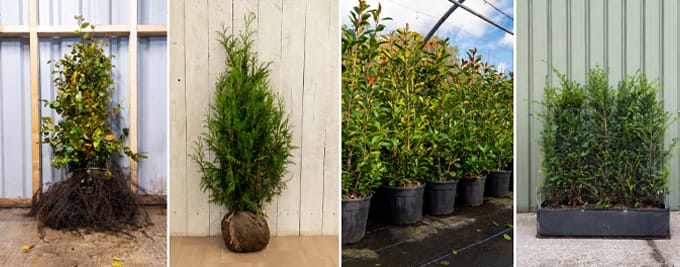
Bare root, root ball, pot-grown and instant hedging suit different budgets, planting times and levels of initial coverage. Understanding how each is…
Read answer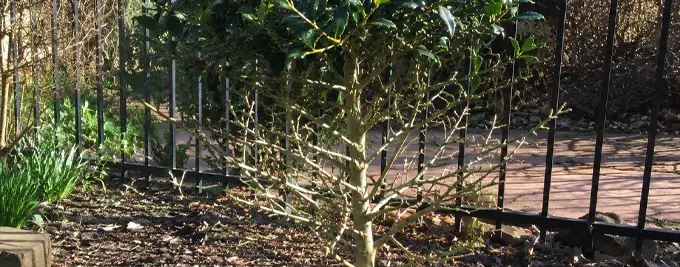
Do Deer and Rabbits Eat Holly Hedging?
Holly's tough, spiny leaves can give the impression that deer and rabbits will leave it alone. In practice, young English Holly can…
Read answer
What Is Holly Transplant Shock and How Long Does It Last?
A newly planted or moved Holly can temporarily lose its glossy appearance, drop leaves or make little new growth while its roots…
Read answer
Can Holly Be Grown as a Hedge in Pots or Containers?
A row of English Holly can create evergreen structure and screening on patios, courtyards and other places where planting directly into the…
Read answer
Is Hornbeam Good for Wildlife?
Hornbeam is a native deciduous hedge with a dense structure that can support birds, insects and small mammals. Its wildlife value depends…
Read answerDo Deer and Rabbits Eat Holly Hedging?
Holly's tough, spiny leaves can give the impression that deer and rabbits will leave it alone. In practice, young English Holly can…
Read answer
Do Birds Eat Holly Berries?
Holly berries are one of the most recognisable features of an English Holly hedge in winter. As well as providing seasonal colour,…
Read answer
When Should Hedges Be Cut to Avoid Nesting Birds?
Hedges provide valuable nesting cover for many British garden birds. Planning routine trimming around the breeding season reduces the risk of damaging…
Read answer