
What Is the Law on Boundary Hedges?
Boundary hedges can raise questions about ownership, maintenance, height and what each neighbour is allowed to cut. The applicable rules also vary slightly between England, Wales, Scotland and Northern Ireland.
Quick Answer
There is no single UK law making every boundary hedge over 2 metres illegal. You can normally cut branches or roots that grow into your property back to the boundary, but you must not cross the boundary or damage the hedge. In England and Wales, councils may consider complaints about qualifying hedges made from two or more mainly evergreen or semi-evergreen plants over 2 metres tall. Different high-hedge legislation applies in Scotland and Northern Ireland.
Quick Facts
| General maximum hedge height | No universal legal maximum |
|---|---|
| The 2 metre rule | A threshold for certain high-hedge complaints, not an automatic height limit |
| Cutting overhanging growth | Usually permitted back to the property boundary only |
| Cutting the hedge top | Requires the owner’s agreement unless required by a council notice |
| Boundary ownership | Depends on deeds, agreements, the planting position and other evidence |
| Council involvement | Normally a last resort after attempts to resolve the dispute |
| Wildlife protection | Active wild bird nests must not be damaged or destroyed |
| Protected trees | Council consent may be needed where trees are protected or within a conservation area |
Who owns a boundary hedge?
Do not rely on the common myth that each homeowner automatically owns the hedge or fence on a particular side of their garden. Ownership depends on the legal boundary, the position in which the hedge was originally planted, title documents, boundary agreements and any available historical evidence.
In England and Wales, Land Registry title plans normally show only the general position of a boundary. They often do not establish the exact boundary line or identify who owns a hedge, wall, tree or fence.
Where a hedge is clearly planted wholly inside one property, it will normally be treated as belonging to that property owner. Where it stands directly over the boundary or was planted and maintained as a shared feature, both neighbours may have rights in it. Neither neighbour should remove or substantially alter a potentially shared hedge without first reaching an agreement.
A title plan marked with a “T” may indicate responsibility for maintaining a particular boundary feature, but it does not necessarily prove ownership of every plant growing along it. Serious disagreements about the exact position or ownership of a boundary are property disputes and may require advice from a boundary surveyor or solicitor.
Can you cut a neighbour’s hedge?
You can normally cut branches or roots that extend from a neighbour’s hedge into your property. You must stop at the property boundary and must not cut into the neighbour’s side, reduce the top of the hedge or enter their land without permission. Cutting beyond the boundary or carrying out work that seriously damages the hedge could result in a claim against you.
You should also:
- check that you are certain where the boundary lies;
- use a suitable cutting method that will not destabilise or kill the plants;
- avoid entering the neighbour’s garden without permission;
- check for protected trees and active bird nests before starting;
- tell the neighbour what you intend to do where practical.
The cut branches and clippings technically remain the hedge owner’s property. They should be offered back, but they must not simply be thrown over the boundary. If the owner does not want them, the person carrying out the trimming should dispose of them responsibly.
Is 2 metres the legal maximum height for a hedge?
No. There is no general rule making every hedge above 2 metres unlawful. The 2 metre measurement is mainly used to decide whether a hedge may qualify for the statutory high-hedge complaints process.
In England and Wales, the relevant rules are contained in Part 8 of the Anti-social Behaviour Act 2003. For a council to consider a complaint, the problem hedge will normally need to be:
- on land owned or occupied by someone else;
- formed by a line of two or more trees or shrubs;
- wholly or predominantly evergreen or semi-evergreen;
- more than 2 metres tall;
- capable of forming a barrier to light or access;
- adversely affecting the reasonable enjoyment of a home or garden.
A single tree does not qualify under this particular process, however tall it becomes. Beech and Hornbeam hedges that retain dead brown leaves in winter are not generally classed as semi-evergreen for the England and Wales high-hedge procedure.
A hedge does not automatically have to be reduced as soon as it passes 2 metres. The council must assess the individual site, the effect on both properties and the wider surroundings. Where action is justified, it may issue a remedial notice specifying the work required and the height at which the hedge must subsequently be maintained.
Do the same rules apply throughout the UK?
The general principles are similar, but the legislation is not identical.
England and Wales use Part 8 of the Anti-social Behaviour Act 2003. Northern Ireland has the High Hedges Act (Northern Ireland) 2011, which also focuses mainly on barriers formed by evergreen or semi-evergreen plants. Scotland uses the High Hedges (Scotland) Act 2013, whose definition can include deciduous as well as evergreen hedges.
Anyone considering a formal complaint should therefore use the current guidance supplied by their own local council rather than assuming that the England and Wales process applies everywhere.
What should you do about a neighbour’s high hedge?
A council complaint should normally be treated as a last resort. In England and Wales, a council can reject an application where the complainant has not taken reasonable steps to settle the matter informally.
A sensible process is:
- Speak to the hedge owner calmly and explain the specific problem.
- Suggest a reasonable height or trimming arrangement.
- Follow up in writing and retain copies of letters or emails.
- Consider mediation where direct discussions have failed.
- Contact the local council if the hedge qualifies and the problem remains unresolved.
Councils can charge a complaint fee, and the amount varies between authorities. Paying the fee does not guarantee that the hedge will be reduced or that the complainant will recover the money from the hedge owner.
The council will normally consider evidence from both parties and inspect the site. It may look at the hedge’s height, species, distance from windows, garden size, ground levels, effect on daylight and contribution to the character of the area before deciding whether action is proportionate.
What if a hedge blocks light or a view?
A tall hedge blocking daylight may support a high-hedge complaint, but the legislation does not guarantee uninterrupted sunlight or a completely open outlook.
Loss of a view by itself is unlikely to be enough to require action. The council considers whether the height of the hedge is adversely affecting the reasonable enjoyment of the home or garden, rather than deciding whether one neighbour prefers the appearance without it.
The high-hedge procedure in England and Wales does not cover problems caused by roots, including alleged subsidence. Root damage, damaged drains and structural movement are separate matters that may require evidence from an arboriculturalist, structural engineer, insurer or solicitor.
Can a hedge be protected by law?
An ordinary line of shrubs is not normally covered by a Tree Preservation Order. However, individual trees growing within an old or established hedge can be protected. Trees within a conservation area may also be subject to additional controls.
Before carrying out major work, check with the local planning authority if the hedge contains mature trees, stands within a conservation area or forms part of a planning condition. Cutting protected trees without the required consent can be an offence.
Wild birds and their active nests are also protected. Hedge cutting is one of the activities capable of damaging nests, so the hedge should always be inspected before work starts. For an ordinary domestic garden hedge, the practical legal test is whether an active nest is present, rather than relying solely on fixed calendar dates. If a nest is being built or used, postpone the work until it is no longer active.
Separate agricultural hedgerow management and removal rules may apply to hedges on farmland and other non-domestic land.
What if the hedge borders a road or pavement?
Hedge owners must prevent their plants from creating a dangerous obstruction over a public pavement or road. If a hedge restricts passage, blocks signs or reduces visibility, the highways authority can require it to be cut back.
If the owner refuses, the authority may arrange the work and recover its costs.
How can you avoid a future boundary hedge dispute?
When planting a new hedge, position the planting line far enough inside your property for the hedge to reach its intended width without repeatedly crossing the boundary. Allow room to trim the sides safely and consider how contractors will gain access once the plants mature.
Agreeing an intended maintained height with the neighbour can prevent misunderstandings, particularly where the hedge will be evergreen and close to windows or a small garden.
Choose a species whose growth rate and eventual size suit the available space. Our guide to the best hedges for privacy in UK gardens explains the main screening choices, while our guide to how and when to trim a hedge covers ongoing maintenance.
Little and regular maintenance is normally easier for both neighbours than allowing a hedge to become extremely wide or tall and then attempting a severe reduction.
When should you seek professional advice?
Obtain professional advice where:
- the exact boundary or ownership is disputed;
- either party intends to remove a potentially shared hedge;
- cutting roots or branches could destabilise mature trees;
- there are allegations of structural damage or subsidence;
- the plants may be protected;
- a council remedial notice has been issued;
- discussions have become hostile or legal proceedings are threatened.
This article provides general information about boundary hedge law and should not be treated as advice for a specific property dispute.
Gwynne's Grower's Tip
One of the most common practical mistakes is planting directly against a fence or presumed boundary without allowing for the hedge’s eventual width. The plants may begin entirely within your garden but soon become difficult to trim without leaning over the fence or entering the neighbour’s land. Mark the legal boundary first, decide the finished width and position the planting line far enough inside your property to keep the mature face manageable. A brief conversation about the intended height before planting can also prevent years of disagreement later.
What Are the Different Hedging Root Types?
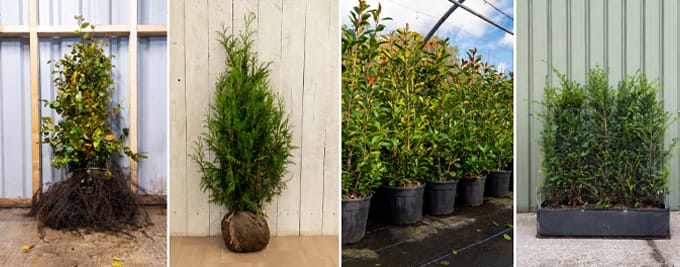
Bare root, root ball, pot-grown and instant hedging suit different budgets, planting times and levels of initial coverage. Understanding how each is…
Read answer
What Is the Best Soaker Hose for Hedges?
A well-chosen soaker hose makes it easier to water a hedge evenly without wetting the foliage or carrying a watering can along…
Read answer
What Is the Best Watering System for a Hedge?
A good hedge watering system should deliver moisture slowly and evenly along the whole planting line. The most suitable setup depends on…
Read answer
Why Is My Hedge Turning Brown?
A hedge can turn brown for several very different reasons, including dry roots, waterlogged soil, frost, wind, trimming damage or disease. The…
Read answer
Is Hornbeam Evergreen? What Does It Look Like in Winter?
Hornbeam is valued for its fresh green summer foliage, warm autumn colour and strong winter structure. Understanding how its leaves behave after…
Read answer
What Do Hornbeam Leaves Look Like?
Hornbeam has distinctive textured foliage that changes noticeably through the seasons. Learning to recognise the leaf shape, veins and toothed edges can…
Read answerWhat Are the Different Hedging Root Types?
Bare root, root ball, pot-grown and instant hedging suit different budgets, planting times and levels of initial coverage. Understanding how each is…
Read answer
Is Privet Evergreen?
Privet is often chosen for privacy, but its winter appearance is less predictable than that of a fully evergreen hedge. The variety,…
Read answer