
What Is Eating My Privet Hedge?
Chewed, notched or stripped Privet leaves can have several causes, and the shape of the damage is often more useful than the amount missing. This guide will help you identify the likely culprit and decide whether your hedge needs treatment.
Quick Answer
Most holes and notches in Privet leaves are caused by adult weevils or leaf-eating caterpillars. Irregular scallops around the leaf edge suggest vine or Privet weevil, while larger ragged holes, droppings or visible larvae point to caterpillars. Neat semicircular cuts are usually made by harmless leaf-cutting bees. Curled leaves are more likely Privet aphid damage, not chewing. Minor damage on an established hedge is usually cosmetic, but wilting pot-grown plants should be checked for vine-weevil grubs in the roots.
Quick Facts
| Irregular notches around leaf edges | Adult vine weevil or Privet weevil |
|---|---|
| Large ragged holes or missing foliage | Leaf-eating caterpillars |
| Neat semicircular cuts | Leaf-cutting bees, usually harmless |
| Tightly curled young leaves | Privet aphid rather than chewing damage |
| Silvery or finely mottled foliage | Privet thrips or spider mites |
| Wilting pot-grown plant with root damage | Check for vine-weevil grubs |
| Best inspection time | Dusk or after dark, when weevils are active |
| Likely effect on an established hedge | Usually cosmetic unless damage is extensive |
Start by looking at the shape of the damage
The easiest way to identify what is eating a Privet hedge is to inspect the damaged leaves closely. Different pests leave recognisably different patterns.
Look at several parts of the hedge rather than relying on one damaged leaf. Check the outer foliage, sheltered inner branches, young shoot tips and the undersides of leaves. It is also worth inspecting the hedge after dark with a torch because adult weevils and some caterpillars feed mainly at night.
Fresh feeding damage normally has a clean green edge. Older damage develops a dry brown edge, which means the pest may already have moved on.
What causes notches around the edges of Privet leaves?
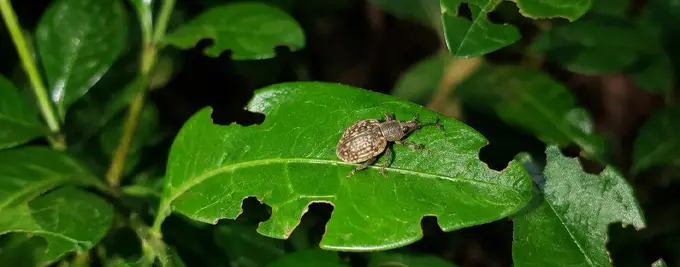
Repeated U-shaped or irregular notches around the leaf margins usually indicate feeding by an adult weevil.
Both vine weevil, Otiorhynchus sulcatus, and related species such as Privet weevil, Otiorhynchus crataegi, can feed on Privet leaves. The dark adult beetles tend to hide during the day and emerge after dusk, which is why they can be difficult to find even when fresh damage is appearing.
Adult leaf feeding is often mainly cosmetic and an established hedge will usually continue growing normally. The more serious concern is vine-weevil larvae feeding on the roots of plants in containers. The larvae are cream-coloured, C-shaped and legless, with a small brown head. Root damage may cause a plant to wilt, grow poorly or become unusually loose in its pot or planting hole. Privet-weevil larvae are not normally considered as damaging to garden plant roots as vine-weevil larvae.
Place a pale sheet, tray or upturned umbrella beneath the branches and gently shake the hedge after dark. Any adult weevils that drop from the foliage will be easier to see against the light surface.
If the hedge remains healthy and the damage is limited to a few notched leaves, treatment may not be necessary. Where a recently planted pot-grown Privet is wilting, inspect the original root ball before assuming the problem is drought or disease.
What causes large or ragged holes in Privet leaves?
Larger holes, ragged leaf edges and partly stripped shoots are more likely to have been caused by caterpillars.
Search among folded or touching leaves, around shoot tips and within the dense centre of the hedge. Look for caterpillars, silk, small dark droppings or leaves that have been held together by fine threads.
Winter moth caterpillars can eat holes in the emerging foliage of many deciduous shrubs during spring. The original holes may appear larger later in the year as the leaf expands, even though the caterpillar is no longer present.
Privet is also a food plant for the Privet hawk-moth, Sphinx ligustri. Its caterpillar is large and distinctive, with a bright green body, diagonal purple and white markings and a curved horn at the rear. Caterpillars are generally seen from July into September and feed on Privet, ash and lilac leaves.
A small number of Privet hawk-moth caterpillars will rarely threaten an established hedge. They are part of the wildlife supported by Privet, particularly Wild Privet, and can normally be left alone. Where numerous caterpillars are seriously defoliating a very young hedge, they can be removed by hand while wearing gloves.
What makes neat semicircular cuts in the leaves?
Smooth, neat semicircles cut from the edge of a leaf are usually the work of a leaf-cutting bee.
Female leaf-cutting bees remove pieces of foliage and carry them away to line their nests. The cuts can be surprisingly precise and may appear on several leaves, but they do not normally affect the vigour of an established hedge.
Leaf-cutting bees are useful pollinators and should not be controlled. Their damage is easily distinguished from the rough, irregular notching left by weevils.
What causes pale patches or tunnels inside Privet leaves?
Brown, pale or winding patches within the leaf can be caused by leaf-mining larvae. These small larvae feed between the upper and lower surfaces of the leaf rather than eating through it from the outside.
Hold an affected leaf up to the light. You may be able to see the mine, larva or a small pupal case within the damaged area.
Leaf-miner damage is normally confined to individual leaves and rarely threatens the complete hedge. Heavily affected fallen leaves can be collected, but otherwise the Privet can usually be allowed to replace the damaged foliage naturally. Hedging Plants Direct’s broader guide to Privet hedge problems, pests and diseases covers leaf miners alongside other possible causes of damaged foliage.
What looks like feeding damage but is not caused by chewing?
Not every damaged Privet leaf has been eaten. Several sap-feeding pests cause distortion or discolouration without removing sections of the leaf.
Privet aphid
Privet aphid, Myzus ligustri, feeds on young Privet leaves and causes them to curl tightly downwards. Open a curled leaf and look for small, pale green or yellow-green aphids inside.
The damage is generally cosmetic on an established hedge and natural predators often reduce the population as the season progresses. Sticky honeydew and black sooty mould may also appear where aphids are numerous.
Privet thrips
Privet thrips, Dendrothrips ornatus, feed on the leaf surface between May and October. They can gradually produce silvery-brown foliage and occasional premature leaf loss, but they do not normally leave obvious holes or missing pieces.
Spider mites
Spider mites can cause fine pale mottling, dull foliage and early leaf fall, particularly during hot, dry weather. Fine webbing may be visible when populations are high.
Use a hand lens to inspect the undersides of affected leaves. Drought stress, thrips and nutrient problems can produce similar symptoms, so pale foliage alone does not confirm spider mites.
Could rabbits or deer be eating the hedge?
Where complete shoot tips are missing rather than individual leaves, inspect the stems for signs of animal browsing.
Deer often pull shoots away, leaving a torn or ragged end. Rabbits are more likely to damage young plants near ground level and may also gnaw the bark. Recent plantings and fresh spring growth are particularly vulnerable.
Young plants can be protected with appropriate guards or fencing, although protection must be large enough to prevent animals reaching over or pushing against it.
What should I do about the damage?
First identify the pest rather than applying a treatment based only on the appearance of one leaf.
For minor damage:
- Inspect the hedge regularly, including after dark.
- Leave harmless wildlife such as leaf-cutting bees and occasional Privet hawk-moth caterpillars alone.
- Remove individual caterpillars by hand where damage is becoming excessive.
- Shake branches over a pale sheet to check for adult weevils.
- Remove only badly damaged leaves rather than cutting away large amounts of healthy growth.
- Keep the root area watered during prolonged dry periods so the hedge can replace lost foliage.
Do not apply additional fertiliser simply because leaves have been eaten. Excessive nitrogen can encourage soft growth and will not correct root damage or an active infestation.
Where vine-weevil grubs are confirmed around the roots, use only a biological or other control currently approved and labelled for that pest, following its temperature, timing and application instructions carefully.
When should the damage be taken more seriously?
Further investigation is advisable when:
- A newly planted hedge is losing a large proportion of its foliage.
- One or more pot-grown plants are wilting despite adequate moisture.
- Cream-coloured grubs are present around the roots.
- Complete branches or stems are being stripped.
- The same hedge is heavily defoliated more than once.
- Bark has been removed near ground level.
- Damage is accompanied by dying stems, poor roots or continuing decline.
Leaf holes alone rarely kill an established Privet hedge. Wilting, root loss, damaged bark or repeated severe defoliation are more significant than a small amount of cosmetic leaf damage.
Gwynne's Grower's Tip
Do not inspect Privet only in the middle of the day. Many of the pests that notch the leaves hide in the hedge, under pots or among surface debris while it is light. Go out after dusk with a torch and hold a white tray or sheet beneath the damaged branches while you tap them gently. Weevils and caterpillars are much easier to find this way. Also look at the edge of the damage. A fresh green edge means feeding is recent, while a dry brown edge often means the culprit has already moved on.
More Privet Advice
For more detailed growing advice or to view the plants available from our nursery, use the links below.
Useful Planting Essentials
Selected products that may help with planting, establishment and ongoing hedge care.

Rootgrow Mycorrhizal Fungi
Rootgrow can be applied at planting so the product is in direct contact with the roots, where appropriate for the plant and planting method.
View product
Hedge Feed
Hedge Feed provides balanced nutrition where established hedging would benefit from feeding as part of normal care.
View product
Hedge Irrigation
A hedge irrigation system can make it easier to water a new hedge consistently, particularly on longer runs and during dry weather.
View product
Hedge Compost & Mulch
Compost and mulch can support soil preparation, moisture retention and weed suppression when used appropriately around new hedging.
View product
How Can I Make a Privet Hedge Grow Faster?
A Privet hedge can grow quickly once its roots are established, but dry soil, weed competition, deep shade and unsuitable pruning can…
Read answer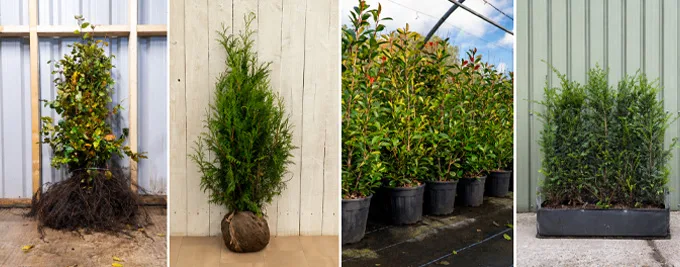
What Are the Different Hedging Root Types?
Bare root, root ball, pot-grown and instant hedging suit different budgets, planting times and levels of initial coverage. Understanding how each is…
Read answer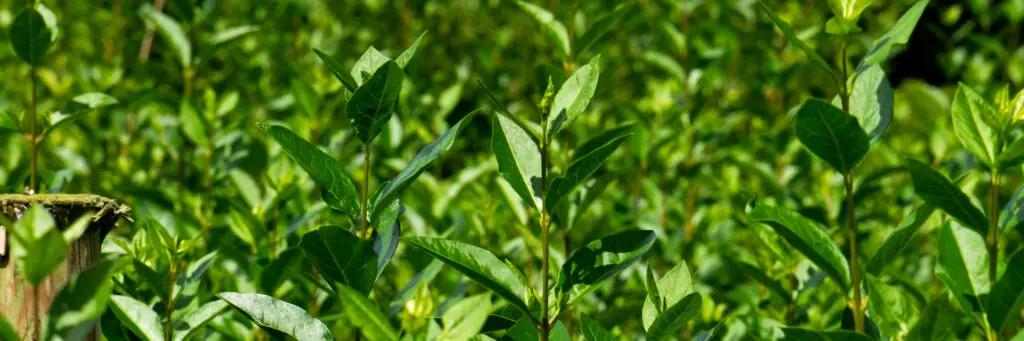
Is Privet Evergreen?
Privet is often chosen for privacy, but its winter appearance is less predictable than that of a fully evergreen hedge. The variety,…
Read answer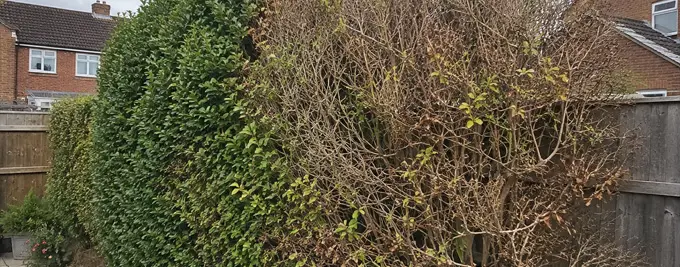
Why Is My Privet Hedge Dying?
A Privet hedge can lose leaves, turn brown or die back for several different reasons. The position and pattern of the damage…
Read answer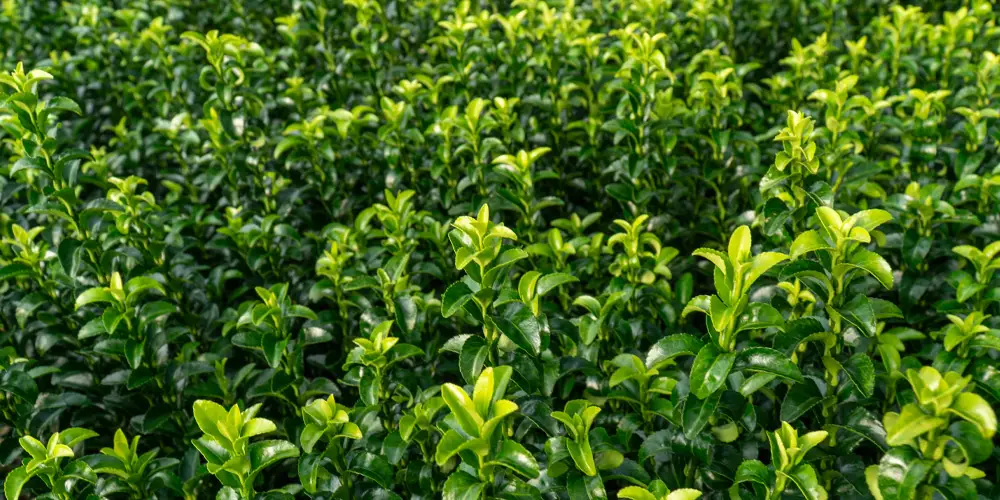
Euonymus Green Spire Problems: Causes and Fixes
Green Spire is a tough, reliable hedge, but a few problems turn up regularly. Here is how to recognise each one quickly,…
Read answer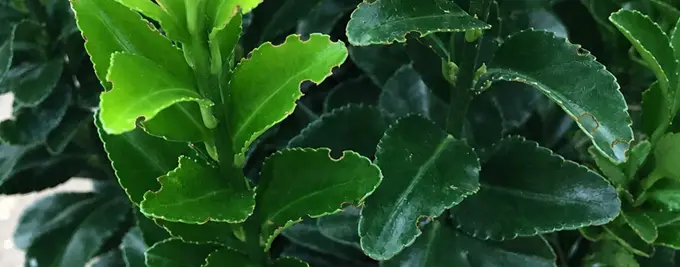
What Causes Notches Around Green Spire Leaves?
Neat-looking bites or irregular U-shaped notches around the edges of Green Spire leaves are a useful diagnostic clue. The visible leaf damage…
Read answer
Do Deer or Rabbits Eat Euonymus Green Spire?
Green Spire should not be regarded as reliably browse-proof. The amount of damage depends heavily on local animal pressure, alternative food and…
Read answer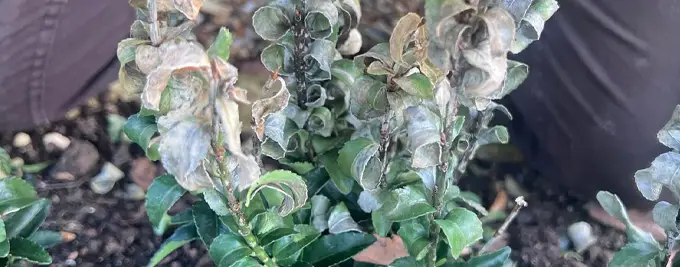
Can Frost or Wind-Damaged Green Spire Recover?
Evergreen Green Spire can show brown leaf edges, scorched foliage or leaf drop after cold drying winds. The visible damage can look…
Read answer