
How and When to Prune a Laurel Hedge
Laurel hedges respond well to regular pruning, but the best timing and method depend on the type of Laurel you are growing. Cherry Laurel has large, broad leaves that are easily marked by hedge trimmers, while Portuguese Laurel has smaller leaves that are better suited to conventional clipping.
For Cherry Laurel, Portuguese Laurel, Upright Laurel and Compact Laurel, carry out the main trim in late spring or early summer, once the risk of hard frost has passed. A second light trim can be made in late summer where a particularly neat or formal finish is required.
This article concentrates specifically on pruning. For advice covering planting, spacing, watering, feeding, growth rates and common problems, read our complete Laurel Hedging Care Guide.
Pruning guide contents
| Laurel type | Main pruning period | Recommended method |
|---|---|---|
| Cherry Laurel | Late spring or early summer, with an optional light late-summer tidy | Secateurs or loppers give the neatest finish on its large leaves |
| Portuguese Laurel | Late spring or early summer, with a second light trim if required | Hand shears or a hedge trimmer can be used on its smaller leaves |
| Upright Laurel | Late spring or early summer | Trim side growth while retaining the leading shoots until the required height is reached |
| Compact Laurel | After flowering or in early summer | Use light selective pruning to preserve its naturally compact shape |
| Sweet Bay Laurel | Spring or summer | Trim back to a healthy leaf or outward-facing bud |
When should you prune a Laurel hedge?
The main pruning period for most Prunus Laurel hedges is late spring or early summer. By this point, the risk of severe frost has normally passed and the plants are actively growing, allowing them to cover pruning cuts with fresh foliage.
This timing applies to:
Formal Laurel hedges can be given a second light trim in late summer to remove untidy extension growth. Keep this second cut light and avoid encouraging a flush of soft new growth immediately before colder autumn weather.
Should Laurel be pruned in winter?
Winter is not normally the best time for routine Laurel hedge trimming. Fresh cuts and exposed foliage can be affected by cold winds and frost, while the hedge will not produce enough active growth to cover the cut surfaces quickly.
Dead, broken or dangerous branches can be removed whenever necessary in suitable weather. However, routine shaping is better left until late spring or early summer.
Can you trim Laurel in late summer?
Yes. A light trim in late summer can help maintain a formal outline and remove long shoots produced after the main cut. Avoid severe reductions at this stage and do not prune during very hot, dry weather, particularly if the hedge is newly planted or showing signs of drought stress.
Cherry Laurel versus Portuguese Laurel pruning
Cherry Laurel and Portuguese Laurel are both evergreen hedging plants, but their leaves and growth habits affect how they should be trimmed.
How to prune Cherry Laurel
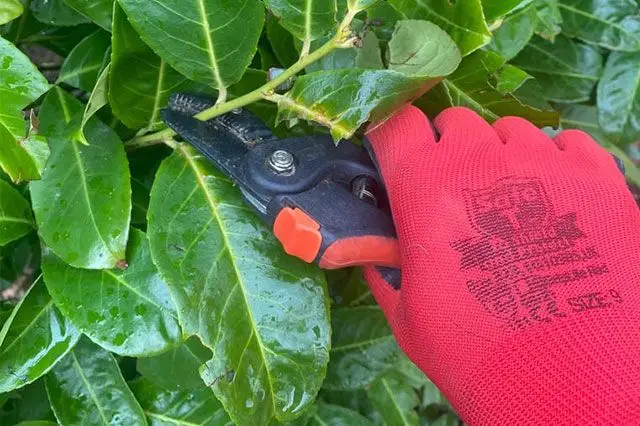
Cherry Laurel has large, broad and glossy leaves. A powered hedge trimmer will cut the hedge quickly, but it will also slice through many of these leaves. The damaged leaf edges can turn brown and leave the hedge looking untidy until new foliage develops.
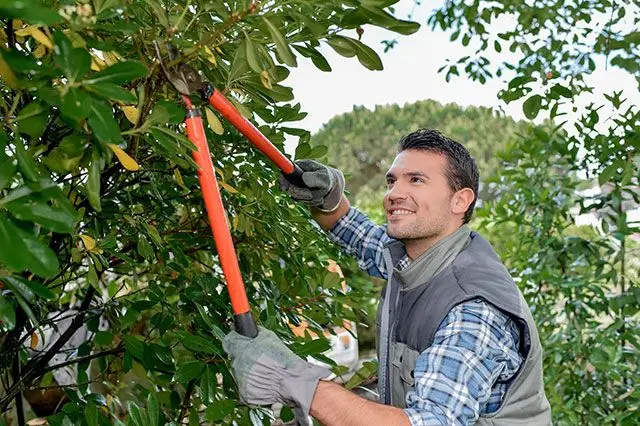
For the neatest result, use secateurs or loppers to cut individual shoots and branches. Make each cut just above a healthy leaf or outward-facing bud, taking care to work around the leaf blades rather than cutting through them.
Using secateurs takes longer, but it is particularly worthwhile on a prominent formal hedge, a short garden boundary or a hedge close to a patio or entrance.
How to prune Portuguese Laurel
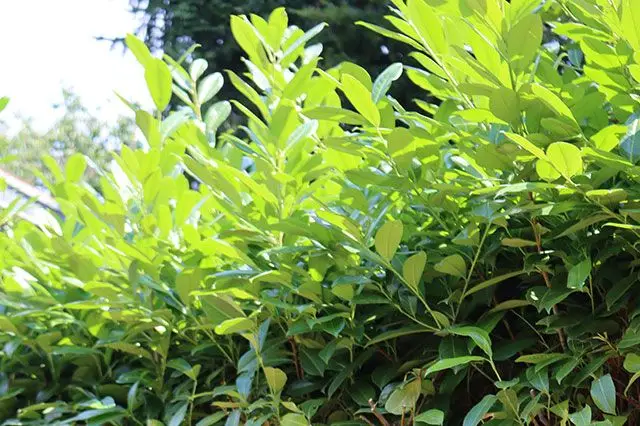
Portuguese Laurel has smaller, narrower leaves and fine reddish young stems. Its foliage is less noticeably damaged by clipping, so it can be maintained successfully with hand shears or a powered hedge trimmer.
One main trim is normally enough for an informal Portuguese Laurel hedge. A formal hedge may need a second light trim in late summer to maintain a precise outline.
Even when using a hedge trimmer, remove thicker, badly positioned or crossing branches separately with secateurs or loppers. This produces cleaner cuts and helps prevent stems from being torn or crushed.
What tools do you need to prune Laurel?
The correct tools will depend on the size of the hedge and the thickness of the stems being removed.
- Secateurs: Best for young shoots, selective trimming and cutting around the large leaves of Cherry Laurel.
- Loppers: Useful for thicker branches that cannot be cut cleanly with secateurs.
- Pruning saw: Suitable for established woody stems during renovation work.
- Hand shears: Useful for shaping Portuguese Laurel and other smaller-leaved varieties.
- Powered hedge trimmer: Suitable for long hedges and smaller-leaved Portuguese Laurel, although it may leave cut edges on Cherry Laurel leaves.
- String line and canes: Helpful when creating a straight top and an even taper.
- Gloves and eye protection: Recommended when handling cut stems or using powered tools.
Make sure cutting blades are sharp and clean before starting. Blunt tools can crush stems and leave ragged cuts. Clean tools between hedges, particularly where disease may be present.
How to prune a Laurel hedge step by step
- Check carefully for nesting birds. Inspect the front, back, top and interior of the hedge immediately before beginning work. Do not prune any section containing an active nest.
- Assess the current shape. Decide how much growth needs to be removed and check that the proposed reduction will still leave healthy foliage across the hedge.
- Set guide lines. Use canes and string to mark the desired height and the line of the sides. This is particularly useful on a long formal hedge.
- Remove dead and damaged branches. Cut dead, broken, rubbing or badly positioned stems back to healthy growth using clean secateurs, loppers or a pruning saw.
- Trim the sides. Work along the hedge in manageable sections. Keep the base slightly wider than the upper section so that light can reach the lower foliage.
- Trim the top. Once the sides are even, reduce the top to the string line. Avoid repeatedly removing the leading shoots from a young hedge that has not yet reached its required height.
- Make selective finishing cuts. Remove projecting shoots and tidy any leaves badly damaged by a hedge trimmer. On Cherry Laurel, use secateurs to improve the final appearance.
- Clear away the clippings. Remove cut foliage from the top and interior of the hedge. Leaving thick accumulations of clippings inside can restrict light and airflow.
Avoid trying to complete a very large reduction with repeated passes of a hedge trimmer. Identify the main branches that need to be shortened and cut them cleanly with loppers or a saw.
Formative pruning for a young Laurel hedge
Formative pruning helps a newly planted Laurel hedge develop a dense base and an even framework. The aim is to encourage side branching without repeatedly removing the shoots responsible for gaining height.
During the first growing seasons
- Remove dead or damaged shoots.
- Lightly shorten long side shoots to encourage branching.
- Allow the main upright shoots to continue growing until the hedge is close to its intended height.
- Begin trimming the top only when the required height is nearly reached.
- Keep the lower part of the hedge slightly wider than the top.
Cutting the top too frequently while the plants are still short can slow the development of height. Equally, leaving the sides completely untrimmed can produce a tall hedge with a thin or open base. Light side trimming provides a useful balance.
Newly planted Laurel should not be heavily pruned simply because it has made limited growth in its first year. Large pot-grown or root-balled plants may initially concentrate on root establishment before producing strong extension growth.
Maintaining the correct tapered hedge shape
A Laurel hedge should normally be slightly wider at the bottom than it is at the top. This sloping profile is sometimes called a taper or batter.
The taper allows more light to reach the lower leaves and reduces the risk of the base becoming thin and bare. A hedge that is wider at the top can shade its own lower growth, eventually creating a top-heavy appearance.
When trimming:
- Set the lower string line slightly farther out than the upper line.
- Trim the sides gradually rather than creating a severe angle.
- Stand back regularly to check the overall profile.
- Check both ends of the hedge rather than judging the line from one position.
- Avoid allowing heavy top growth to overhang the sides.
The taper does not need to be dramatic. A slight, consistent slope is normally enough to maintain good light levels at the base.
How to hard prune an overgrown Laurel hedge
Cherry Laurel and Portuguese Laurel are generally capable of producing new shoots from older wood, making them more suitable for renovation than many conifer hedges. However, a large reduction can place considerable stress on an old, dry, recently planted or unhealthy hedge.
Carry out major renovation in spring after the risk of severe frost has passed. Where more than approximately half the hedge needs to be removed, a staged renovation over two or three growing seasons is usually safer than cutting the entire hedge back at once.
A staged renovation plan
First year
- Reduce one side of the hedge to the required position.
- Leave the opposite side and the height largely unchanged.
- Maintain a slight outward taper.
- Mulch the root area and water during prolonged dry weather.
- Allow a full growing season for recovery.
Second year
- Reduce the opposite side once strong regrowth has developed.
- Continue watering during dry periods.
- Delay the next stage if recovery is weak.
Third year
- Reduce the height to slightly below the final level required.
- Allow the new shoots to develop before beginning routine trimming.
Some healthy, vigorous Cherry Laurel hedges can withstand a more substantial one-stage reduction, but staged pruning produces less shock and retains more screening while the hedge recovers.
Do not apply large quantities of fertiliser to a severely droughted or waterlogged hedge. Correct watering and drainage problems first. A spring mulch and a suitable balanced feed can support regrowth where the plants and soil conditions require it.
How to prune frost-damaged Sweet Bay Laurel
Sweet Bay Laurel, or Laurus nobilis, is a different plant from Cherry and Portuguese Laurel. It prefers a warm, sheltered position and is more vulnerable to severe frost and cold, drying winds.
After a cold winter, the tips or outer foliage may turn brown. Do not immediately cut the whole plant back during freezing weather. Wait until late spring, when new growth begins and the full extent of the damage is easier to identify.
Once active growth is visible:
- Remove clearly dead shoot tips.
- Cut back to healthy wood, a green leaf or an outward-facing bud.
- Avoid removing healthy lower growth unnecessarily.
- Reduce badly damaged or overgrown Bay gradually where possible.
- Water during dry weather while the plant recovers.
Mature Bay can recover from relatively hard pruning, but it normally regrows more slowly than Cherry Laurel. Renovating a large Bay hedge over two or three seasons is therefore often the better option.
Check Laurel hedges for active bird nests before pruning
Dense Laurel hedges can provide useful shelter and nesting cover. All wild birds, their eggs and nests are protected by law while a nest is being built or used.
The main bird breeding period is commonly associated with spring and summer, but birds can nest outside the usual season. You should therefore inspect the hedge before every pruning job, regardless of the month.
Look and listen for:
- Adult birds repeatedly entering the same part of the hedge.
- Birds carrying nesting material or food.
- Alarm calls or distressed behaviour near the hedge.
- A visible nest, eggs or young birds.
If you find an active nest, stop work and leave the surrounding section undisturbed. Postpone cutting until the young have fledged and the nest is no longer in use. Do not attempt to move the nest to another part of the hedge.
Common Laurel pruning mistakes
Pruning routinely in late winter
Routine hedge shaping in late winter exposes fresh cuts and foliage to frost. Save the main trim for late spring or early summer. Spring renovation pruning is a separate task and is used specifically to restore a badly overgrown hedge.
Cutting through every Cherry Laurel leaf
A hedge trimmer is fast, but the broad leaves of Cherry Laurel will show cut brown edges. Use secateurs for the best appearance or tidy the most visible damaged leaves after mechanical trimming.
Creating a hedge that is wider at the top
A top-heavy profile shades the lower foliage and can result in a bare base. Maintain a slight taper, with the bottom wider than the top.
Cutting the top of a young hedge too soon
Allow the leading shoots to grow until the hedge is close to its intended height. Concentrate early pruning on lightly shortening the sides and encouraging basal growth.
Hard pruning a stressed hedge
A hedge suffering from drought, waterlogging, root damage or severe disease may recover poorly from a major reduction. Identify and correct the underlying problem before undertaking renovation.
Ignoring nesting birds
Never assume a hedge is empty because no nest can be seen from the outside. Inspect the interior carefully and stop immediately if bird activity suggests that a nest is present.
Frequently asked questions about pruning Laurel hedges
What month is best for cutting a Laurel hedge?
Late spring or early summer is normally the best period for the main trim of Cherry Laurel, Portuguese Laurel, Upright Laurel and Compact Laurel. A light second trim can be carried out in late summer if required.
How often should a Laurel hedge be trimmed?
One main trim each year is sufficient for many informal Laurel hedges. Formal hedges may need a second light trim in late summer to maintain a precise outline.
Can Laurel be cut back hard?
Healthy Cherry and Portuguese Laurel usually respond well to hard pruning and can produce new shoots from old wood. Very large reductions are safer when completed gradually over two or three growing seasons.
Will a Laurel hedge grow back after being cut down?
Cherry and Portuguese Laurel can often regrow from established stems, but recovery depends on the health of the roots, soil conditions, watering and the severity of the cut. Sweet Bay generally recovers more slowly.
Can I use a hedge trimmer on Cherry Laurel?
Yes, but a hedge trimmer will slice through its large leaves and may leave temporary brown edges. Secateurs or loppers provide a cleaner appearance by allowing you to cut individual stems between the leaves.
Can I prune Laurel in September?
A very light tidy may be possible in early September during mild conditions, but avoid severe cutting that encourages soft growth before winter. The main trim should normally be completed in late spring or early summer.
Should I feed a Laurel hedge after pruning?
A healthy established hedge in reasonable soil does not automatically need feeding after every trim. Following hard renovation, a balanced spring feed may help where growth is weak, but watering, drainage, mulching and weed control should be addressed first.
More Laurel hedge advice
This pruning article supports our main Laurel Hedging Care Guide, where you can find detailed information about choosing a variety, planting distances, watering, feeding, growth rates and diagnosing common problems.
You can also browse our complete range of Laurel hedging plants, including Cherry Laurel, Portuguese Laurel, Upright Laurel, Compact Laurel and Sweet Bay Laurel.